HISTORICAL BACKGROUND
The South African Democracy Education Trust (SADET) was established as a project Trust after President Thabo Mbeki indicated his concern about the paucity of historical material on the arduous and complex road to South Africa's peaceful political settlement after decades of violent conflict. Following discussions with the private sector core funding of R6 million over a two-year period was provided by Nedcor and MTN.
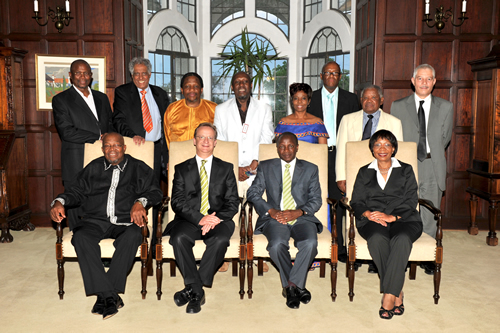
A Board of Trustees, chaired by Dr Essop Pahad, and including Minister Lindiwe Sisulu, Professor Yvonne Muthien and Mr Jacques Sellschop of MTN, Dr Ivan May of Nedcor, Isaac Makopo of the MK Veteran's Association, Seth Phalatse, Professor Vincent Maphai, and Professor Ben Magubane (SADET), was appointed. Mr Jacques Sellschop left the Board after his resignation from MTN in 2002. Selby Baqwa (SC), the former Public Protector, replaced Dr Ivan May as Nedcor's representative on the Board following the latter's resignation from Nedcor in June 2003.
Dr Meshack Khosa replaced Professor Muthien as MTN representative on the Board in early 2006, and was in turn replaced by Mr Nkateko Nyoka in late 2006. Dr Eddy Maloka joined the Board in 2005, while Mr Joe Matthews joined in 2006.
A project management and research team was subsequently appointed, and consisted of Professor Ben Magubane (Project Leader), Dr Gregory Houston (Project Coordinator), Dr Sifiso Ndlovu (Senior Researcher) and Mrs Elsa Kruger (Project Administrator).
In 2004 Dr Houston was appointed Executive Director and Professor Magubane Editor-in-Chief, while Dr Sifiso Ndlovu was appointed Director of Research in 2006.
_________________________________________________
FROM THE CHAIRMAN: SADET BOARD OF TRUSTEES
The banning of the liberation movements in 1960 and the subsequent turn to armed struggle led to a dramatic change in the lives of millions of South Africans. Participation in the sabotage campaign and other underground activities, exile, military training and action, imprisonment, death in detention, banishment, constant surveillance and harassment, and general involvement in the struggle against apartheid characterized the lives of many of our people for the next thirty years. Their experiences form part of the tapestry of our country's history. Chronicling this history is a major task, and a serious responsibility that has been given to the South African Democracy Education Trust (SADET).
Our Trust Board brings together leading politicians, businessmen, veteran activists and academics that are entrusted with the task of guiding and assisting in the execution of this research endeavour. From the outset the Board, appointed in mid-2000, faced the daunting task of setting up a new organisation. These tasks included writing up the deeds of the Trust, the conditions and contracts of employment, establishing bank accounts, seeking a management and research team, office space, sponsorship for furniture, computers and other office requirements, etc. One of the Board members, Professor Yvonne Muthien, played a central role in these areas. Other members of the Board provided valuable assistance to Professor Muthien.
During the course of the year under review Board members have assisted the core SADET team in both the management and research areas. Board members have brought into SADET a wealth of management and research experience that has augmented the SADET team's capacity to deal with a wide variety of related issues.
The academics entrusted with the task of doing the research, led by Professor Ben Magubane, have succeeded in setting up six regional research teams, and have made continuous progress in the research endeavour. In the process they have succeeded in making the Road to Democracy Project a truly national project.
An exciting development has been the research decision on the publication of the first volume, a volume on the 1960s, by the end of April 2004, the tenth anniversary of the democratic South Africa. This has been coupled with the vast strides the researchers have made in interviewing numerous veterans of the struggle in so many parts of the country. The Board was keen that the SADET researchers interview as many veterans as possible, and with the utmost urgency since so many of them are reaching the end of their exemplary and illustrious lives. Their oral testimonies are an invaluable contribution to our effort to record our country's history. Elsewhere in this report there is evidence of how the organization is progressing with the research.
We thank the President, Mr. Thabo Mbeki, for initiating the idea
for this project as well as his continued support. This is also
an opportunity for the Board to thank MTN and Nedcor for providing
the core funding for the project, and to thank the other sponsors,
in particular the Fuel Energy Fund, Compaq and Tarsus, for the donations
they have made.
The Board also expresses its appreciation for the energy with which
the Project Leader and his management and research team are working
to make SADET a leading agency in the recording of our country's
history.
Dr Essop Pahad
Chairperson: SADET Board of Trustees
 To top
_____________________________________________________
Professor Ben Magubane (Project Leader)
FROM THE SADET PROJECT LEADER
The SADET management and research team moved into the SADET offices in the Nedbank building in Church Street, Pretoria, on the 1st September 2000. The offices, donated by Nedcor for SADET's use, was once the Dutch embassy and Klaas de Jonge's home for two years while he was keeping out of the reach of the South African apartheid authorities. Broll Properties has since taken ownership of the building, and has kindly agreed to SADET's continued use of the premises free of charge. Nedcor, the Strategic Fuel Fund, Tarsus, and Compaq provided office space, furniture, computer equipment and other office requirements through generous donations. The SADET management team's immediate task was to secure contracts with established research institutions and to create research teams in various parts of the country to carry out the research. The first contract was signed with the Africa Institute of South Africa on the 18th September 2000. The core research team then traveled to Cape Town, East London and Durban in October to meet with prospective research team leaders and members for the Western Cape, Eastern Cape and KwaZulu-Natal regions, respectively. Contact was established with the Wits History Workshop and the team began negotiating a contract with the Human Sciences Research Council (HSRC). Negotiations with established institutions and the creation of research teams took a large part of the first twelve months, and the final contract was signed in June 2001.
The highlight of 2001 was the successful launch of the Road to Democracy Project on the 21 March, 2001 by the President, Mr. Thabo Mbeki. Invited guests who attended the function at the Presidential Guest House in Pretoria included the CEO's of MTN and Nedcor, the Deputy President, various Cabinet Ministers, members of political parties, members of the foreign diplomatic corps, former anti-apartheid activists, businessmen, and ordinary members of the public. The publicity generated through the launch was followed by interviews I gave on radio, and to various newspapers.
Regular Trust Board meetings have been held - on average every two months - with regular financial statements and research reports submitted by the SADET management and research team at all board meetings.
In line with the goal of making this a truly South African project and with drawing in as many people as possible into the project contracts were signed with six participating institutions/research teams, bringing approximately twenty-six more researchers into the project. The first phase of the research has been a focus on interviews, leading to the interviewing of approximately 500 people at this stage. Participating institutions/research teams have been submitting research reports to the Board every two months, indicating continuous progress. By the end of the first twelve months all systems had been put in place to ensure that the research process becomes truly national in character.
Project proposals were submitted by the Africa Institute of South Africa; the Human Sciences Research Council; the Wits History Workshop; a Western Cape research team made up of academics from the Universities of the Western Cape and Cape Town, and the Robben Island Museum; an Eastern Cape research team consisting of staff members from the Govan Mbeki Research Centre at Fort Hare University, and researchers from the Universities of Port Elizabeth, Rhodes and Transkei; and KwaZulu-Natal team made up of researchers from the University of Natal.
Project proposals submitted by the participating institutions/research teams included interviewing people in their individual regions, such as the Northern Province and Mpumalanga by the Africa Institute of South Africa, as well as specific topics/themes which have particular relevance to a region, such as a study of Inkatha by the KwaZulu-Natal team. Regional teams have also undertaken other activities on their own initiative. The Western Cape team, for example, held a SADET exhibition and meeting in Cape Town on the 11th August 2001, on the June 16 uprising in the Western Cape.
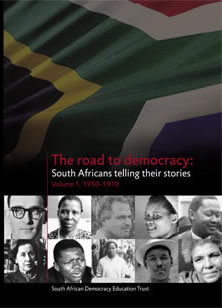
An editorial committee, comprising researchers from the various teams and the SADET research team, has been set up and decisions have been made regarding the first publications - a collection of oral histories and the first volume on the 1960s. Individual researchers from the various participating institutions/research teams have completed the final drafts of their chapters for the first volume, to consist of 17 chapters, which SADET expects to publish by April 2004. In addition, the process was carried out by holding various national workshops of the editorial team made up of representatives from all the participating institutions and the SADET research and management team. Work is to begin on the second volume soon.
A number of meetings aimed at linking the SADET project with various other national projects, such as the National Oral History Project of the Department of Arts, Culture, Science and Technology, the "Freedom Park" (Cadres Abashokobezi) project of the Department of Defence, and the South African History Project of the Department of Education, have taken place during the year. In large part, these meetings have indicated an awareness of the significance of the SADET project amongst those leading other national research projects. It was also clear that SADET could make a major contribution to these national projects, and ways of collaboration were sought.
In consequence, Dr Sifiso Ndlovu was appointed to serve as a member of the Ministerial History Committee under the auspices of the Ministry of Education's South African History Project. The project was set up by the Minister of Education in order to strengthen the teaching of History in South African schools, to enhance the Ministry's capacity to allow all of us to celebrate our history, to bolster our national identity, to enthuse our children and youth, to bring us closer as individuals and as communities and to allow us to ensure that no resurgence of the negative elements of our past will impair our future.
Dr Sifiso Ndlovu and Professor B. Magubane also serve as Advisory
Panel members of the Freedom Park Trust, which is presently funded
by the Department of Arts, Culture, Science and Technology. Freedom
Park is a Grade 1 Cabinet-approved Legacy Project because it is
a heritage resource with qualities so exceptional that they are
of special national significance. It strives to accommodate all
of the emerging experiences and symbols that unfold to tell one
coherent story of "Humanity's Struggle in South Africa".
It will serve as a place to balance and engage the fragmented propensities
of our multi-cultural, multi-class and multi-ethnic society.
The SADET management team held meetings with representatives of
Print Media in Education, IMAX, and NU-Metro. These meetings were
aimed at introducing the SADET project to the three bodies, but
also represented an excellent opportunity for SADET to gear itself
to meet its long-term objectives. There was general acceptance at
these meetings that SADET will be able to cooperate with these bodies
to take its products, such as documentaries, short-life histories,
popular historical texts, etc., to a wide audience via the print
media and popular film outlets.
SADET has also provided assistance to other research projects, including assisting the late Mr Govan Mbeki with his manuscript on the political history of Port Elizabeth. Another major initiative was the autobiographical/political history manuscript of Mr James Ngculu, Member of Parliament. SADET provided assistance to the latter by editing the manuscript and connecting Mr Ngculu with a publisher. The SADET team also assisted Mrs Tembeka Mufamadi with her work on the biography of Mr. Raymond Mhlaba. The team helped Mrs Gertrude Shope trace the people who were banished during the apartheid era. SADET provided office space to Mrs Elinor Sisulu, who is conducting a major study of Mr. Walter Sisulu, and Joyce Sikhakhane-Rankin, who has just completed the first draft of Mrs Albertina Sisulu's biography.
In the course of the year the SADET management and research team has established a range of contacts that have provided valuable assistance to the research process. These contacts have been initiated by individual Trust Board members such as the Chairperson of the Board, Mr Isaac Makopo, General Masondo, and Dr Ivan May, members of the SADET research and management team, and members of the participating institutions/research teams. In effect, researchers in the various regions have found widespread enthusiasm for the project amongst people they want to interview. Many of the people interviewed have voiced their appreciation for the opportunity the project provides them "to tell the true story".
The SADET office has been visited by a number of scholars from overseas and has established contacts with scholars and organizations from abroad. SADET has established contact with the Nordic Africa Institute, the Commissie Archieven Nederland - Zuidelijk Afrika, and the Department of History of the University of Hannover, Germany. SADET has already received copies of the published volumes on the role of the Nordic countries in the struggle for liberation in Southern Africa from the Nordic Africa Institute. The office has been visited by people such as Ineke van Kessel, author of Beyond our wildest dreams: The United Democratic Front and the Transformation of South Africa and Hans Georg Schleister, author of Special Flights: The GDR and liberation movements in Southern Africa.
Klaas de Jonge visited the offices during the year with a television crew from Holland to record his reminiscences about his stay in what are currently SADET's offices. The hour long interview of Mr de Jonge conducted in the SADET offices was aired on NPS-Television's weekly programme "Ander Tijden". The programme deals with a reconstruction of events in twentieth century history.
One of the most significant interviews conducted by the SADET team was with the late Dr. Percy Yutar, prosecutor in the Rivonia Trial. Dr. Yutar showed the SADET research team an unpublished manuscript on the Trial, as well as press clippings on the Rivonia Trial and Soweto uprising. Linkage was also established with the owners of Lilliesleaf Farm, where Dr. Yutar hoped to have some parts of his collection displayed.
Finally, let me take this opportunity to thank my fellow Board members, the staff at the SADET head office, the members of the participating institutions/research teams, and all those who made a contribution to the progress we have made in our project.
Professor Ben Magubane (Project Leader)
See more on SADET's History
Historical Background | Road to Democracy | Sponsers | Related Links | Contact | Interviews | History
© 2015 SADET - All Rights Reserved