Publications:
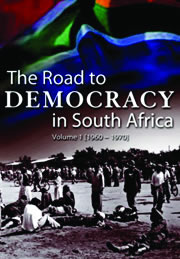
- The Road to Democracy in South Africa, Volume 1, 1960-1970
- The Road to Democracy in South Africa, Volume 2, 1970-1980
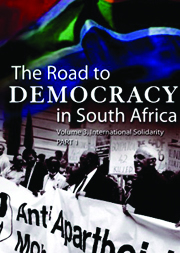
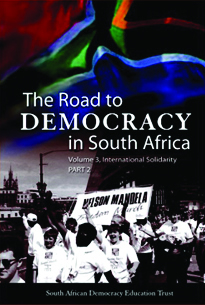
- Road to Democracy in South Africa, Volume 3, International Solidarity
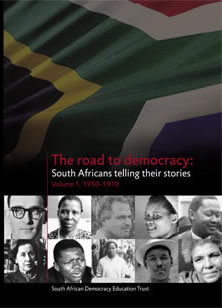
- The Road to Democracy: South Africans telling their stories, Volume 1, 1950-1970
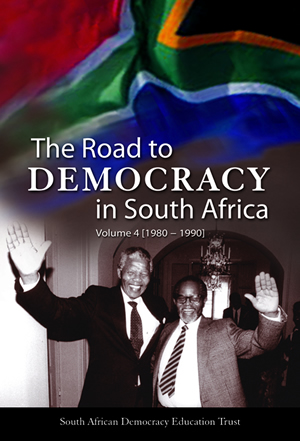
- The Road to Democracy in South Africa, Volume 4, 1980-1990
- The Road to Democracy in South Africa, Volume 5
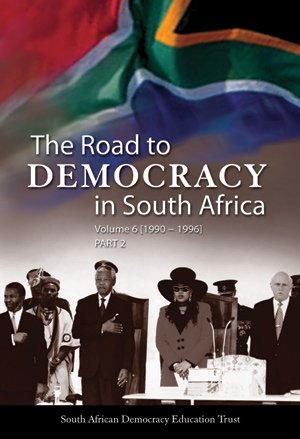
- The Road to Democracy in South Africa, Volume 6, 1990-1996

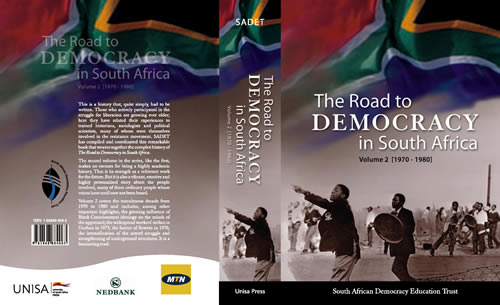
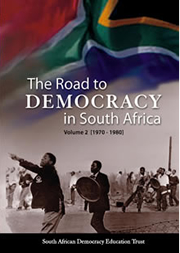
The Road to Democracy in South Africa, Volume 2, 1970-1980
South African Democracy Education Trust
CONTENTS
Chapter 1 - Introduction to the 1970s: The Social and Political Context - By Bernard Magubane
Chapter 2 - From Détente to the Rise of the Garrison State - By Bernard Magubane
Chapter 3 - The Black Consciousness Movement -By Mbulelo Vizikhungo Mzamane, Bavusile Maaba and Nkosinathi Biko
Chapter 4 - Culture, Resistance and Representation - By Bhekizizwe Peterson
Chapter 5  - The Revival of the Labour Movement, 1970-1980
- By Jabulani Sithole and Sifiso Ndlovu
- The Revival of the Labour Movement, 1970-1980
- By Jabulani Sithole and Sifiso Ndlovu
Chapter 6 - White Activists and the Revival of the Workers’ Movement - By Dave Hemson, Martin Legassick and Nicole Ulrich
Chapter 7 - The Soweto Uprising
Part 1 Soweto
Contents
iv The Road to Democracy in South Africa, Volume 2 - By Sifiso Mxolisi Ndlovu
Part 2 Alexandra and Kathorus - By Noor Nieftagodien
Part 3 Thembisa - By Noor Nieftagodien and Tshepo Moloi
Chapter 8 - The ANC Political Underground in the 1970s -
By Gregory Houston and Bernard Magubane
Chapter 9 - The ANC’s Armed Struggle in the 1970s - By Gregory Houston and Bernard Magubane
Chapter 10 - The ANC Underground in Natal - By Jabulani Sithole
Chapter 11 - The Liberation Struggle in the Eastern Cape - By Janet Cherry and Pat Gibbs
Chapter 12 - The ANC’s Diplomacy and International Relations - By Sifiso Mxolisi Ndlovu
Chapter 13 - The PAC’s Internal Underground Activities,
1960-1980 - By Thami ka Plaatjie
Chapter 14 - The PAC in Exile - By Thami ka Plaatjie
Chapter 15 – Resistance and Repression in the Bantustans – By Bernard Magubane
Part 1 Transkei and Ciskei – By Lungisile Ntsebeza, Luvuyo Wotshela, Thembela Kepe, Sukude Matoti and Andrew Ainslie
Part 2 Bophuthatswana – By Bernard Mbenga and Andrew Manson
Chapter 16 – Neither Communists nor Saboteurs: KwaZulu Bantustan Politics – By Jabulani Sithole
Chapter 17 – Aboveground organisations and activities
Part 1 Aspects of aboveground activity – By Christopher Saunders
Part 2 NUSAS in the 1970s – By Martin Legassick
Part 3 The revival of the Natal Indian Congress – By Uma Dhupelia-Mesthrie
Background
The South African Democracy Education Trust (SADET) was established as a project Trust after President Thabo Mbeki indicated his concern about the paucity of historical material on the arduous and complex road to South Africa’s peaceful political settlement after decades of violent conflict.
Core funding for SADET was provided by MTN and the Nedbank Group. In 2004 MTN became the leading sponsor of the project, while the National Lottery Distribution Trust Fund gave SADET a research grant. SADET’s activities are overseen by a Trust Board, chaired by the Minister in the Presidency, Dr Essop Pahad, and includes Minister Lindiwe Sisulu, Dr Meshack Khosa of MTN (replacing Dr Yvonne Muthien in 2005), Adv. Selby Baqwa (SC)(the Nedbank Group), General A. Masondo (retired Chief of Service Corps, South African National Defence Force), Mr Isaac Makopo (MK Veteran’s Association), Mr Seth Phalatse, Dr Vincent Maphai, Dr Eddy Maloka (Africa Institute of South Africa), and Prof. Bernard Magubane (SADET). A project management and research team was formed, consisting of Prof. Bernard Magubane (Project Leader), Dr Gregory Houston (Project Coordinator), Dr Sifiso Ndlovu (Senior Researcher) and Mrs Elsa Kruger (Project Administrator). In 2004 Dr Houston was appointed Executive Director and Prof. Magubane Editor-in-Chief.
Mission
SADET’s mission is to examine and analyse events leading to the negotiated settlement and democracy in South Africa. The study will lead to the publication of 5 volumes of research on the successive decades in the run up to the first democratic elections.
Terms of reference
The Road to Democracy project is a chronological analysis of four decades, namely 1960-1970, 1970-1980, 1980-1990 and 1990-1994. It investigates the following themes:
-
Political context: the political dynamics of each decade.
-
Key organisations and prominent individuals involved.
-
Strategy and tactics of important liberation organisations, including their debates and the influence of these decisions on revolutionary developments.
-
The response of the apartheid regime to activities of liberation movements.
-
The role of the international community in the liberation of South Africa and international events and processes that came to bear on the liberation struggle.
-
Regional events and processes that impacted upon the liberation struggle.
-
The major outcomes at the end of each decade.
The Road to Democracy
Volume 2, 1970–1980
 This book retains the objective set for the first volume, namely
that of providing new insight into the operation of the liberation
movements. It does so by drawing on previously untapped documentary
sources such as trial records, state archives and the archival records
kept by the liberation movements themselves. More importantly, however,
it includes the voices and experiences of scores of those directly
involved in the struggle, those who courageously and selflessly
fought the apartheid regime in the 1970s. Some paid with their lives
but others, some of whom went into exile and others who suffered
torture and lengthy jail sentences, have survived to tell their
tale. Their experiences have been recorded by a team of researchers
working for SADET in different parts of the country, and this endeavour
has yielded an incomparably rich archive of personal testimonies.
This is SADET’s particular legacy for the future.
This book retains the objective set for the first volume, namely
that of providing new insight into the operation of the liberation
movements. It does so by drawing on previously untapped documentary
sources such as trial records, state archives and the archival records
kept by the liberation movements themselves. More importantly, however,
it includes the voices and experiences of scores of those directly
involved in the struggle, those who courageously and selflessly
fought the apartheid regime in the 1970s. Some paid with their lives
but others, some of whom went into exile and others who suffered
torture and lengthy jail sentences, have survived to tell their
tale. Their experiences have been recorded by a team of researchers
working for SADET in different parts of the country, and this endeavour
has yielded an incomparably rich archive of personal testimonies.
This is SADET’s particular legacy for the future.
Volume 2 draws on this fount of oral and documentary evidence to provide important new insights. The first two chapters comprise a study of the political, economic and social context within which the struggle for liberation was fought. They show unequivocally that by the end of the decade South Africa had indeed become a garrison state, and in so doing they unpack the many determinants of this situation, including the changing relations between the apartheid regime and the West; the changing geo-political situation that followed the independence of Mozambique and Angola; and the impact of important resistance moves such as the 1973 Durban strikes and the Soweto uprising.
Black Consciousness in South Africa arose from the deepening crisis under apartheid, and began to affect a new generation of racially oppressed groups that were obliged to devise new strategies to cope with their existential situation. The ideology found expression in many forms but was generally closely in tune with popular needs, particularly those of black students in the late 1960s and in the 1970s. In chapter 3 the history of the Black Consciousness Movement (BCM) is traced. Student struggles of the early 1970s are also carefully recorded, as is the apartheid state’s reaction. Core material includes a scholarly analysis of the uprising in Soweto, the murder of Steve Biko in police detention and the outlawing of Black Consciousness organisations in October 1977.
Between 1957 and 1966, a large number of artists left South Africa using exit permits which prohibited any subsequent return to South Africa. The activities of artists (especially performers and musicians) who remained in the country were to be deeply circumscribed by the outlawing of black performers and audiences frommost venues in so-called ‘white areas’. Against the backdrop of this ‘cultural vacuum’, chapter 4 explores the significant resurgence of cultural work in the 1970s and the emergence of a new generation of black writers and artists under the influence, in varying degrees, of Black Consciousness ideology.
The revival of the workers’ movement was arguably one of the most important developments of the 1970s. The mass wave of strikes in January 1973 involved some 60 000 workers and led to the formation of a number of significant trade unions. This was followed by the school student movement in 1976 that sparked the uprisings in Soweto and in other parts of the country, and gave rise to the first political general strikes since 1961. These events are discussed in chapter 5, where the focus falls on the five distinct groups that were involved in the revival of the black trade union movement. The analysis of SACTU activities shows how the international working class movement was lobbied to engage in solidarity work with South African workers. There were also strenuous efforts to establish and strengthen existing trade unions throughout the African continent, overcoming a number of problems and challenges.
Another examination of the 1973 Durban strikes and the subsequent
rise of the trade union movement is made in chapter 6. Here the
authors emphasise the role of white intellectuals in the nascent
trade union movement and examine the debates and issues confronting
these new organisations and their activities.
Chapter 7 begins with a study of the origins of the 1976 Soweto
uprising and focuses on a number of important imperatives including
the role of Afrikaner nationalist ideology, socio-economic structural
changes affecting Soweto and the educational and epistemological
issues surrounding the use of Afrikaans as a medium of instruction
in black schools. The centrality of the language issue as a cause
of the uprisings and the role of the South African Students Movement
(SASM) are also addressed. This is followed by a detailed account
of the fateful events as they unfolded on 16 June 1976 in Soweto
and the subsequent unrest in parts of the country.
In chapter 8 the emphasis falls on the efforts to establish an internal ANC political underground by those who decided not to go into exile. In the early part of the decade the loci of underground activity were individuals and small groups of ANC members who had been active in the underground in the 1960s. A small core of youths based in schools and universities began to join the existing networks and to establish their own underground cells. They were then joined by ANC members who had completed prison sentences ranging from 8 to 12 years on Robben Island. These underground activities are discussed and analysed in some detail. Also under scrutiny are the efforts of members of the ANC based abroad to establish a political underground inside the country. Attention is also given to the role of propaganda activists, and the efforts of the ANC to conduct political work among established political and community organisations.
The activities of the ANC’s military wing, Umkhonto we Sizwe (MK), during the 1970s is charted in chapter 9. The discussion begins by looking at early, largely unsuccessful efforts to infiltrate bands of MK cadres. Thereafter, MK activity was revived in the aftermath of Mozambican independence in 1975. This and the uprisings in Soweto and elsewhere in 1976 caused a dramatic expansion of armed resistance and these are the focus in the subsequent sections of the chapter, where MK operations inside South Africa run by machineries in Mozambique and Botswana are discussed. The chapter concludes with a discussion of the training facilities in Angola and MK’s more spectacular operations during the decade.
The history of the ANC’s political and military underground inside the country is the subject of chapter 10, which focuses specifically on the activities of underground ANC operatives working in Natal. The recovery and regrouping process began after the release from Robben Island of Natal ANC, South African Communist Party (SACP) and MK leaders and cadres in the the early 1970s. The analysis shows that this political recovery occurred in two broad phases. The first ran from 1972 to 1976 and the second from 1977 to 1980. The well known Harry Gwala underground network, based in the Natal Midlands from 1972 to the end of 1975, operated alongside two other underground networks which had regrouped between the end of the 1960s and the early 1970s. The chapter concludes with a discussion of the arrest of members of the ANC underground and their detention, trials and sentencing.
The history of the ANC’s political and military underground is addressed in chapter 11. This discussion focuses on the western part of the Eastern Cape province, in particular the Port Elizabeth and Uitenhage industrial area and other small towns in the formerly ‘white’ commercial farming areas. In this region there are two phases of clearly identifiable political activity. The first, from 1975 to 1978, emanated from within the student movement; the other began in about 1979, arising from the civic and worker movement. The events of the mid to late 1970s are discussed in an attempt to analyse developments in the liberation struggle in this region, an area that has hitherto received relatively little attention from struggle historians.
Chapter 12 focuses on the ANC’s diplomatic struggle and its international relations during the 1970s. It begins with an analysis of ANC opposition to John Vorster’s counter-revolutionary ‘outward looking policy’ and his attempts to initiate ‘dialogue’ with various African countries. It then gives an appraisal of the standoff between the ANC and the OAU’s Liberation Committee and the efforts of the OAU to forge unity between the ANC and PAC. There is also an examination of the ANC’s relationship with fraternal organisations and liberation movements, paying particular attention to the ANC’s presence in Angola and its collaboration with the MPLA. The ANC’s interaction with the USSR and its diplomatic manoeuvres at the UN that led to the South African suspension from that organisation in 1974, also receive attention.
Two chapters have been devoted to the PAC in this volume in order to cover the 1960 to 1980 period. The key underground activities of the PAC occurred after two major aboveground actions: the March 1960 anti-pass campaign that ended with the Sharpeville massacre and the march on parliament in Cape Town at the end of the same month. These were the insurgent activities of Poqo. However, the PAC’s aboveground and underground activities were fraught with leadership conflicts. These were ongoing and became a debilitating feature of internal PAC politics that was to dog the organisation’s footsteps. Chapter 13 begins by examining how internal leadership conflicts affected the activities of the PAC during the 1960s. For a large part of this decade the PAC was in disarray, with a considerable number of its leaders and members sentenced to short terms of imprisonment for their actions during the anti-pass campaign. Consequently it was only in 1961 that the remnants of the leadership and those released from prison were able to regroup and set plans in motion for Poqo’s underground activities. A brief analysis of these is included, with the emphasis on how they impacted upon underground activity for more than a decade following the series of mass arrests in 1963.
In Chapter 14 the exile experience of the PAC is covered, beginning with the establishment of external offices, the formation of the PAC’s military wing, the Azanian Peoples Liberation Army (APLA), and its activities until the late 1970s. However, no sooner had the PAC established itself in exile than it began to experience leadership problems again; these plagued the organisation throughout its exile, and this study focuses on these upheavals as a background to the 1969 Moshi conference, as well as their impact on the organisation’s armed struggle. The outbreak of the student uprising on 16 June in Soweto helped to swell the ranks of the PAC with large numbers of student recruits, and its military wing was boosted. The significance of this influx of new members is analysed and it is shown how this exacerbated the tensions between Potlako Leballo and Templeton Ntantala. Reference is also made to the events leading to the decisive Arusha Conference in 1978 and the expulsion of Ntantala and his faction from both the PAC and the leadership of the APLA High Command. The Bethal Treason Trial of the PAC’s internal leadership is also briefly examined, with particular reference to its impact on the conduct of the armed struggle.
Chapter 15 has two sections that deal with resistance and repression in the Bantustan areas. In the first, the consolidation of the Bantustan strategy in the Transkei and Ciskei are examined and incidents of resistance to this strategy are discussed. The role of Chief K.D. Matanzima in Transkei and Chief L. Sebe in Ciskei in the consolidation of the Bantustan strategy is highlighted, including their ruthless tactics in suppressing opposition in their respective fiefdoms. This section, then, deals with the processes leading to ‘independence’ in these two homelands, and resistance to the new Bantustan authorities from 1963 to 1980. In the same vein, the path to ‘independence’ in Boputhatswana is traced.
The struggles that ensued during the creation of the KwaZulu Bantustan are explored in chapter 16. It is shown that Chief Buthelezi neither opposed nor resisted Bantu Authorities and the Bantustan system. It is argued that at one level, Buthelezi’s shifting position on the question of independence was a result of the relationship that his political movement, Inkatha, had developed with the ANC from its formation in March 1975 to June 1980. At another level it is posited that this was a consequence of the ANC and Communist Party’s vacillating positions on the Bantustans during the 1970s.
The subject of chapter 17 is the activity of aboveground organisations during the 1970s. Many of these were organisations that had stepped into the vacuum created by the banning of the liberation movements and extensive state repression during the 1960s, and had been active in earlier decades. The chapter is divided into three sections. The first deals with the more open and organised kinds of resistance, which tended to be undertaken, for the most part, by those least subject to repression. Only a small range of examples is discussed, including the opposition parties in the white parliament, religious institutions opposing apartheid, the Black Sash, student and university staff, sport organisations, resistance literature and the media. The second section examines the history of NUSAS during the 1970s and among the emphases here are the impact of the formation of SASO and the role of the NUSAS Wages Commissions. The revival of the Natal Indian Congress in the early 1970s is addressed in the final section, where the debates around the NIC’s revival are examined. Also discussed are the NIC’s relations with the BCM and its role in the revival of the South African Indian Congress (SAIC), a significant member of the Congress Alliance in the liberation struggle.
Notes on contributors
Andrew Ainslie is in the process of completing a PhD in social anthropology at University College, London. His research interests include the study of agrarian change, specifically land reform and livelihoods in southern Africa.
Nkosinathi Biko is the chairperson of the Steve Biko Foundation. He has participated extensively in activities surrounding the investigations into his father’s death.
Janet Cherry is currently a research associate at the Nelson Mandela Metropolitan University in Port Elizabeth.
Uma Dhupelia-Mesthrie is an associate professor of history at the University of the Western Cape.
Pat Gibbs lectured in history at Vista University in Port Elizabeth in the 1990s. She is currently writing a chapter for a book on women’s history in South Africa, commissioned by the Human Sciences Research Council.
Dave Hemson is a research director in the Urban, Rural and Economic Development Research Programme at the HSRC. He has a PhD in sociology from the University of Warwick.
Gregory Houston is SADET’s executive director, and is a chief research specialist at the HSRC. He has a PhD from the University of Natal.
Thami ka Plaatjie is currently senior manager of strategy and policy at the National Development Agency. He is a former registrar of Vista University (Sebokeng Campus).
Thembela Kepe (PhD) is with the Programme for Land and Agrarian Studies (PLAAS) at the University of the Western Cape.
Martin Legassick is professor of history at the University of the Western Cape and is currently acting director of the Institute of Historical Research.
Brown Maaba is project manager at the Ifa Lethu Foundation. He has researched and published in the field of liberation history in modern South Africa.
Bernard Magubane, SADET’s editor-in-chief, is Professor Emeritus in Anthropology at the University of Connecticut. He has published extensively.
Sukude Mangwevandile Matoti, university planner at the University of Transkei, was a lecturer in history methodology at the University from 1983.
Andrew Manson lectured at the University of North-West (Mafikeng) where he was professor of history until 2005.
Bernard Mbenga is a senior lecturer in history at North-West University, Mafikeng Campus. He has a PhD (Unisa) on the history of the Pilanesberg District.
Tshepo Moloi works as a coordinator at the History Workshop,
University of the Witwatersrand.
Mbulelo Vizikhungo Mzamane, former vice chancellor at the University
of Fort Hare, is author and editor of several scholarly publications.
Sifiso Ndlovu is a senior researcher at SADET. He has a PhD in history from the University of the Witwatersrand.
Noor Nieftagodien is a senior researcher at the History Workshop (University of the Witwatersrand) and has published on local township politics from the 1960s to 1990s.
Lungisile Ntsebeza (PhD) is associate professor in the Department of Sociology at the University of Cape Town.
Bhekizizwe Peterson is associate professor of African Literature
at the University of the Witwatersrand.
Christopher Saunders is professor of history at the University of
Cape Town and has published extensively on twentieth-century South
African history.
Jabulani Sithole is a lecturer in historical studies at
the University of Natal, Pietermaritzburg.
Nicole Ulrich is currently registered for an MA degree at Wits University
and is a researcher at the History Workshop.
Luvuyo Wotshela (PhD) is a lecturer in historical studies at the University of Fort Hare. He specialises in twentieth-century South African history with a focus on homeland policy and resettlement.
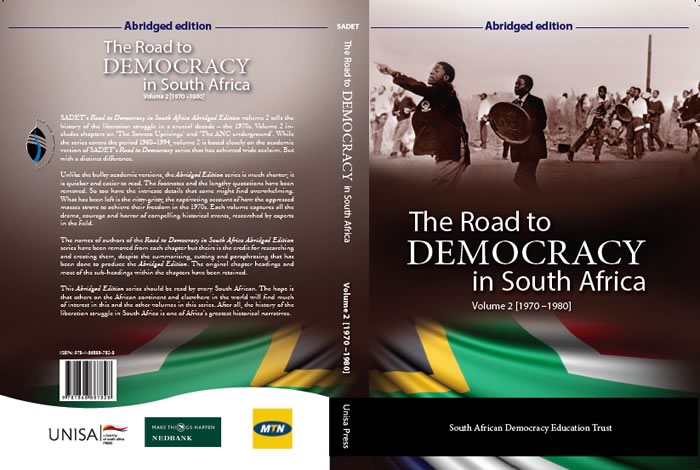
ABRIDGED COVER

About Us | Road to Democracy | Gallery | Sponsers | Contact | Interviews | Home
© 2010 SADET - All Rights Reserved